Money
Payment accounts
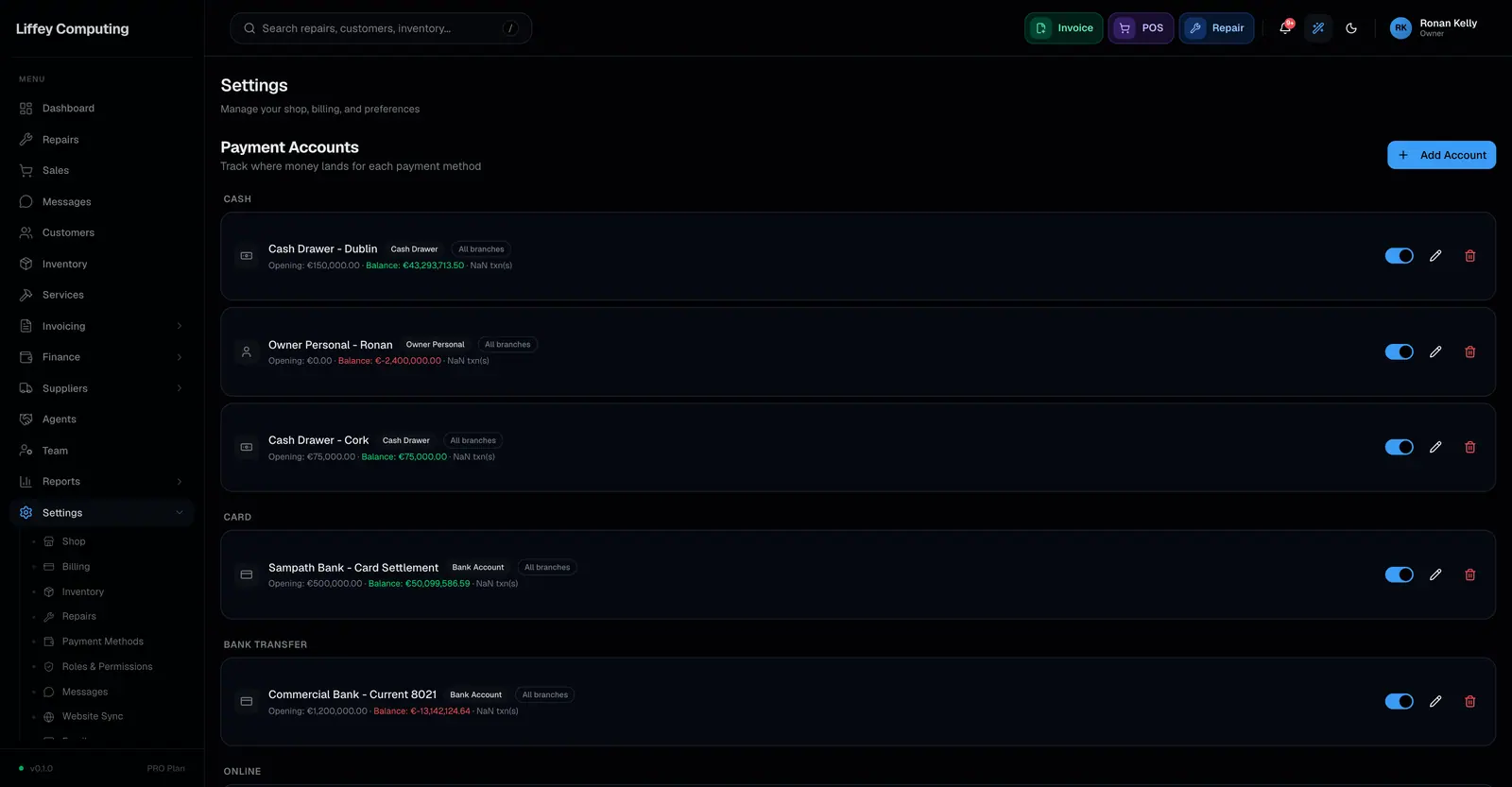
An account is a real place money sits: a cash drawer, a bank account, a mobile wallet, or the owner's own pocket. Every payment, refund, expense and supplier payment records which account it touched, and transfers move money between them.
What it does
Knowing you took fifty thousand today is less useful than knowing how much of it is in the drawer and how much reached the bank.
Accounts have a type, an opening balance, and optionally a branch. An account with no branch is shop wide. One with a branch belongs to that branch, which is how two shops keep separate drawers.
Money moving from the drawer to the bank is a transfer, recorded with an amount, a date, a note and who did it. It is not two unexplained adjustments.
Each payment method can name a default account, so a card payment lands in the right place without anyone choosing every time.
Every capability
| Types | Cash drawer, bank, mobile wallet, owner personal, other |
|---|---|
| Scope | Shop wide, or belonging to one branch |
| Opening balance | Set per account |
| Touched by | Payments, refunds, expenses, supplier payments, owner transactions |
| Transfers | Between accounts, with amount, date, note and who moved it |
| Default account | Each payment method can name one |
| Deactivate | An account can be made inactive without losing its history |
| Display | Colour, icon and sort order, so the list matches the counter |
| Web orders | Cash on delivery and online collections route to accounts you choose |
Questions
What is the difference between an account and a payment method?
A method is how the customer paid. An account is where the money went. Card is a method, and the bank account it settles into is an account.
Can two branches have their own cash drawer?
Yes. Give each account a branch. An account with no branch is shared across the shop.
How do I record cash banked at the end of the week?
As a transfer from the drawer to the bank account. It is one record with a note, rather than a fall in one balance and a rise in another.