Running the business
Website sync
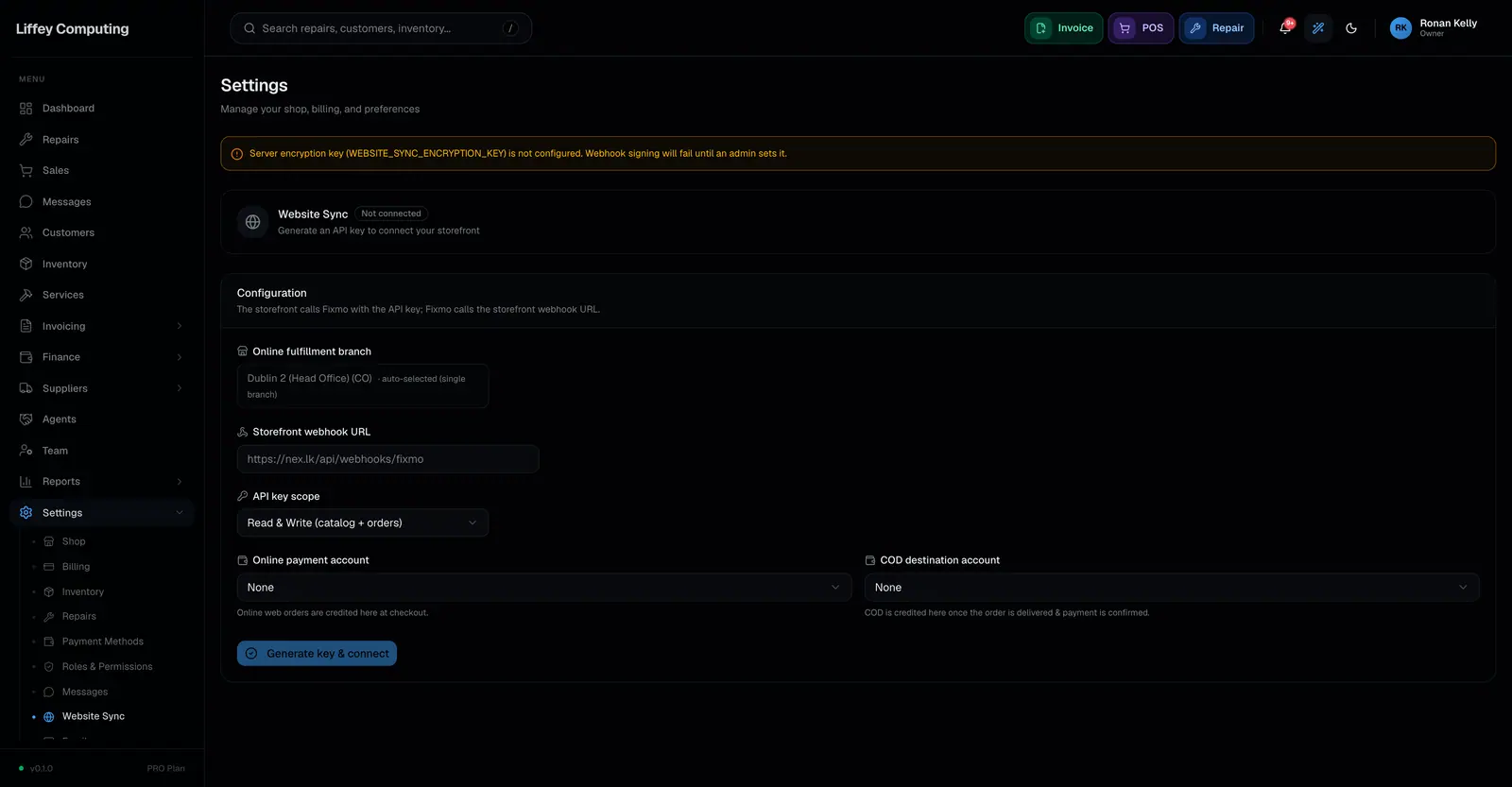
Fixmo exposes an API a storefront can connect to. Products, stock and categories flow out, orders and customers flow in, and stock is held by a reservation while a customer checks out so the same unit is not sold twice.
Website sync requires Pro or Business. It is not available on Free.
What it does
A shop with a website has the same problem twice: which system is right about stock. Usually neither, by Friday.
Fixmo is the authority. Stock, price, name and category come from here, and the storefront follows.
An item can also carry a web price, so the website sells it for a different price than the counter. A web sale can run on top of it, with its own end date. Leave the web price empty and the website uses the shop price and the shop's own sale, as before.
The till charges the sell price. If a customer saw the web price online, staff can still give it to them in the shop, once Show web prices at the counter is on in Settings → POS. The bill marks that line as a web price.
From version 1.3 of the API, a storefront can send its price edits as web prices, so changing a price online does not have to move the counter price.
Orders come the other way, arriving as sales with their own origin so web orders are distinguishable from counter sales in every report.
A checkout holds stock with a reservation that expires. Abandoned baskets release their hold rather than tying up stock forever.
Changes are pushed out as webhooks with signatures and retries. Each event records how many attempts it has had and the last error, and events carry their source so a storefront does not process the echo of its own write.
The connection is authenticated by an API key that is shown once, and stored only as a hash. Cash on delivery and online collections each route to a payment account you choose.
Every capability
| Fixmo is authoritative | For stock, price, name and category |
|---|---|
| Publishing | Only items flagged to list are sent |
| Web price | Optional per item, with a timed web sale on top |
| Photos | A main photo, up to 8 more, and one per variation |
| Descriptions | One per product, and an optional one per variation |
| Counter price | Never changed by a web price |
| Web price in the shop | Off by default, and marked on the bill when used |
| Web order check | A line charged a different price shows in the price override report |
| Orders in | Arrive as sales with a web origin |
| Reservations | Hold stock during checkout and expire on their own |
| Reservation states | Active, released, expired, consumed |
| Webhooks | Inventory, stock, category, customer and sale events |
| Delivery | Signed, retried, with attempts and the last error recorded |
| Echo protection | Events carry their source so a storefront can ignore its own writes |
| API key | Shown once, stored as a hash, with a read-only or read-write scope |
| Fulfilment branch | Web orders belong to a branch you nominate |
| Payment routing | Cash on delivery and online each land in an account you choose |
| Fulfilment status | Ordered, shipped, delivered, cancelled |
Questions
Does Fixmo build me a website?
No. It provides the API a storefront connects to. The storefront itself is yours.
What stops the same item being sold twice?
A reservation holds the stock while the customer checks out, and expires if they do not finish.
Can my website sell at a different price from the shop?
Yes. Give the item a web price, and a web sale if you want one. The till keeps charging the sell price unless you switch on web prices at the counter.
Which system wins if stock disagrees?
Fixmo. Stock, price, name and category are authoritative here and the storefront follows.
What happens if my site is down when stock changes?
The webhook is retried, and the attempts and last error are recorded so a failure is visible.