Running the business
Permissions in detail
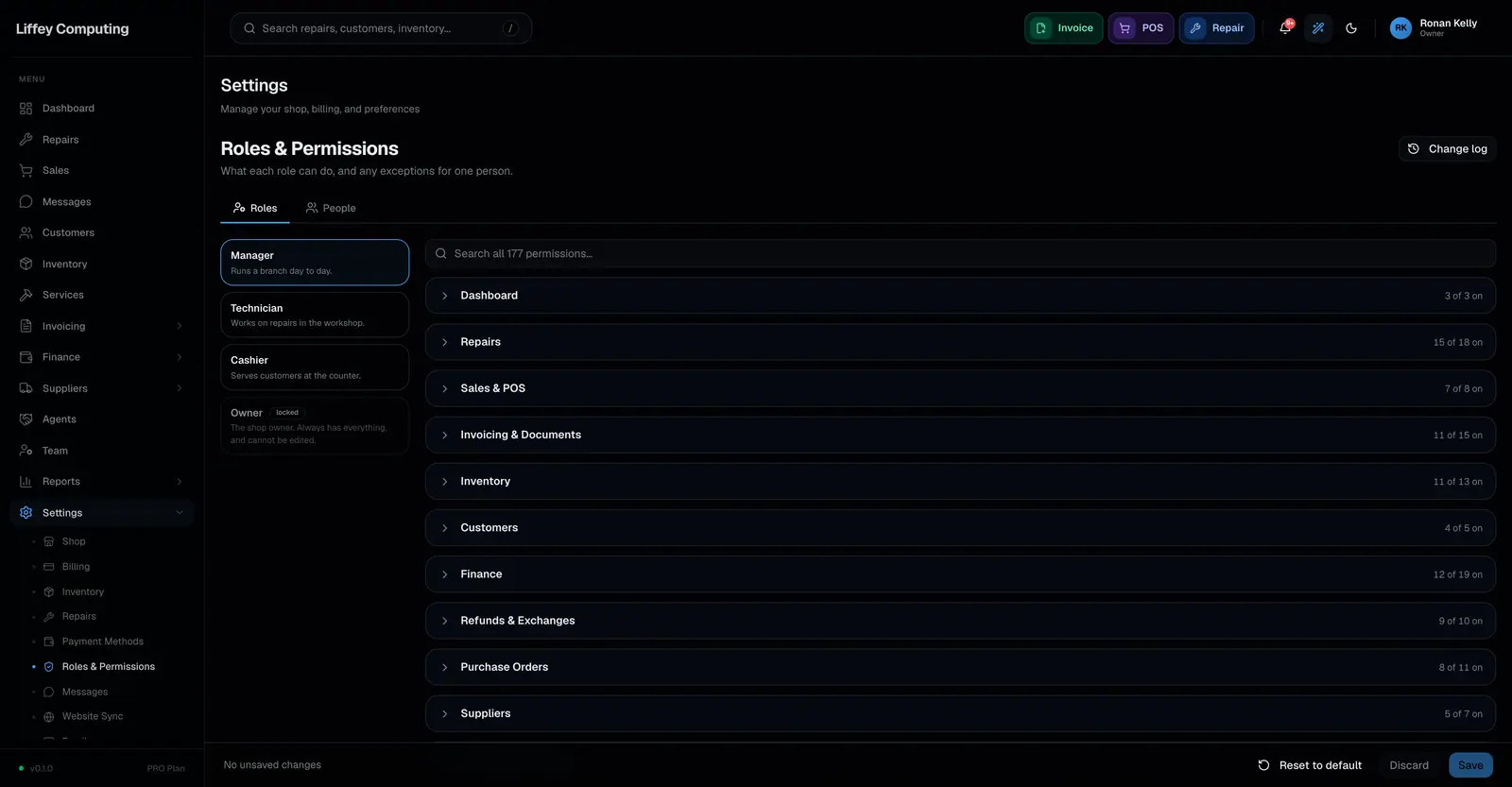
Beyond the four roles, Fixmo exposes 182 individual permissions grouped into 18 modules. Each can be set for a whole role or for one person, and some control how far a module's queries reach: their own records, their branch, or everything.
What it does
Roles are a good starting point and a bad finishing point. Every shop has one manager who should not see payroll, or one technician who also does the ordering.
So each permission can be set on a role, or on a single person. A setting on the person wins over the setting on their role.
No setting at all means inherit, which is what makes resetting to default a matter of removing the exception rather than re-applying a template.
Some permissions are about reach rather than yes or no. A module can be scoped to a person's own records, their branch, or the whole shop.
Every change is logged with who made it, what it was before, what it became, and why. Changes made as a knock-on effect of another change are marked as such, so a cascade reads differently from a deliberate toggle.
Every capability
| Permissions | 182 keys |
|---|---|
| Modules | 18, from repairs and sales to integrations and search |
| Set on | A role, or one person |
| Precedence | Person, then role, then the built-in default |
| Inheritance | No setting means inherit, so resetting removes rather than rewrites |
| Scope | Own records, branch, or everything |
| Cross-tenant | Shop isolation is unconditional and is not a permission |
| Audit log | Actor, target, key, old value, new value and reason |
| Reasons | Manual, cascade, role reset, user reset, role change, backfill |
| Batches | Changes made together share a batch id |
| Recorded with | IP address and browser |
Questions
Can I give one technician extra access without changing the role?
Yes. Set the permission on that person. It overrides their role, and everyone else on that role is unaffected.
What does resetting to default do?
It removes the exception rather than writing a new value, so the person or role goes back to inheriting whatever the default is.
Can a permission let someone see another shop's data?
No. Separation between shops is unconditional and is not something a permission can reach.
Is there a record of who changed a permission?
Yes, including the previous value, the new value, the reason, and whether the change was deliberate or a consequence of another change.